
Understanding Motivation: Why We Do What We Do


Geoff is a highly qualified, experienced and accredited Executive Coach and Mentor (EMCC / BPS) he is also a Fellow of the Chartered Institute of Management Accountants.
Geoff started his coaching career in sport, he translated the skills into life and business and has adopted a coaching philosophy whenever working with and leading individuals / teams in industry.
Geoff adopts a science backed approach to coaching and mentoring, he is a lifelong learner with Masters degrees in Psychology, Strategic Business Management (Distinction), a First Class degree in Sustainable Performance Management and a Level 7 diploma in Executive Coaching and Mentoring from the Institute of Leadership and Management.
Geoff is altruistic by nature and derives a huge amount of satisfaction from supporting and enabling businesses and individuals achieve their intrinsic and extrinsic goals.
I am a member of the EMCC and abide by the Global Code of Ethics.
COACH & MENTOR, EIA, EMCC Global, SENIOR PRACTITIONER, HOGAN CERTIFIED
At times it seems as though we are on autopilot, we get out of bed and get on with our day making lots of decisions. Some of these decisions may be habitual or relatively benign but at other times they may be more challenging - so what is the common denominator?
The American Psychological Society (2018) defines motivation as “The impetus that gives purpose or direction to behaviour and operates in humans at a conscious or unconscious level".
But what makes us more motivated to make difficult or uncomfortable decisions or choose some tasks over others although we know they will be more challenging?
The answers are in psychology and neuroscience. Put simply, it is how we respond to the prospect of achieving a goal or how our individual brains balance a habit or stimulus with the predicted reward that we will receive from carrying out the activity.
In this article we’ll focus on our motivation for achieving goals, not only ours but also for those that we lead.
The Science of Motivation
There are many reasons why we are motivated to select and fulfil our goals. The Yerkes Dodson law (pictured below) demonstrates the levels of stimulation required to optimise performance.
A good starting point is determining whether you are under- or over-stimulated, as both extremes can be suboptimal for performance. The key is to find the sweet spot - the ideal level of motivation that drives optimal productivity and engagement, both for personal growth and also in effective leadership, where balancing motivation levels can help you enhance both your own performance and that of others.

This philosophy can also be translated into learning, to get meaningful and lasting change our brain adopts a neuroscientific concept called neuroplasticity which is the way that our brain changes and develops throughout our life with the stimulus of learning and experiences.
Learning and goals must be suitably challenging, if they are too easy, the changes may not yield meaningful outcomes, be sustainable, or create lasting impact. For example, if we internalised at an early age that we would not succeed and this belief was repeatedly reinforced, then the brain will have been ‘hardwired’ to memorise this assertion.
Changing these patterns is possible, but deeply ingrained pathways take more time and effort to rewire - it's simply a challenge to overcome.
What are some of the reasons for choosing the goals that we do?
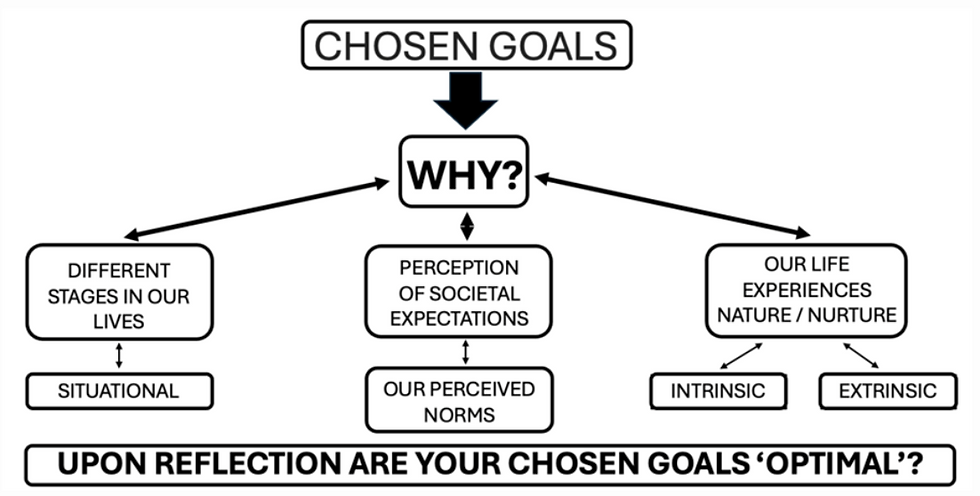
Revisiting Your Goals: Are They Still Relevant?
We can tend to get ‘carried away’ or ‘stuck in a rut’ when it comes to goals. We don’t always understand why we selected them originally or revisit them to make sure that they are still relevant. Have you ever stopped to ask yourself:
Why did I select this goal in the first place?
Is it still relevant to my life or work?
Are my behaviors aligned with achieving it?
To understand your goals better, consider the following:
1. What they are
What are your goals, and what purpose do they serve? Are they aligned with your lifestyle or in conflict? A well-chosen goal should challenge and motivate you while feeling meaningful and sustainable.
Consider the benefits - are they intrinsic or extrinsic? Research suggests intrinsic goals driven by personal growth, fulfillment, and passion are more rewarding than extrinsic ones, which are focused on validation or material gains. Prioritise what truly fulfils you. For example, studying to expand your knowledge brings deep satisfaction, particularly when you apply what you've learned in life and career. The intrinsic reward of becoming more effective in your workplace can lead to extrinsic benefits like promotions or salary increases.
Set goals relevant to your circumstances. Avoid comparing yourself to others or measuring progress against societal expectations - your life is yours to shape, and you define success. Focus on goals that bring personal fulfilment and growth. Comparing yourself to others is neither productive nor healthy; instead, let your progress be driven by what truly benefits and inspires you.
2. Why you have them
Choose goals that hold true purpose and meaning in your life. If a goal is superficial, you're less likely to stay committed - just like the 80% of New Year’s resolutions that fade away. To fully engage with your goals, start by understanding why you’re pursuing them. For example, if you decide to go to the gym three times a week, ask yourself why? Is it for social interaction? To adopt a healthier lifestyle? Or because exercise enhances cognitive function, which you want to apply in your workplace?
Clarify what you genuinely want to achieve, then structure your activities to align with that goal. Track your progress in a way that keeps you motivated. For instance, if your goal is weight loss, set a clear target - such as losing X kg in X months - by going to the gym X times a week and adjusting your diet. A good idea is measuring progress weekly instead of daily to avoid discouragement and stay motivated by recognising meaningful improvements.
You may decide to sustain your weight after you’ve fulfilled the initial weight loss goal and this can be made by making sustainable adjustments to your lifestyle.
3. How you prioritise them
When considering your goals, think about what is important. Prioritise and weight them, trying to keep the number of goals to just two or three so you can focus on their achievement and avoid becoming overwhelmed.
Discuss your goals and their prioritisation with relevant family or colleagues. Aligning your objectives with those around you can help you understand the broader impact and minimize potential conflicts. This not only provides support but also reduces the stress of pursuing goals in isolation or facing opposing expectations. Try to think of the holistic impact of prioritising, pursuing and fulfilling your goal.
Conclusion
There are neuroscientific and psychological theories on motivation, some of which have been more widely challenged than others. Ongoing research continues to either support or question these theories. In true coaching fashion, I recommend further research to help inform your decisions.
As an exercise start to reconsider your goals, what decisions you are making, what goals you have chosen and most importantly – why.

I hope you enjoy your journey! If you want some support contact me for an introductory chat at geoff@geoffsimcoach.com.

PBI Take
Motivation is often treated as a personal trait. But psychology and neuroscience tell a very different story. Using well-established psychological principles and practical reflection questions, this blog invites you to pause, recalibrate, and ask a deceptively simple question:
Are the goals you’re chasing still the right ones?
A timely read for anyone leading others, building a business, or trying to create meaningful change without burning out.


Comments